


English Version
In the competitive world of chess, interviews can often be a challenging ordeal for players, who are typically absorbed in their intense preparation schedules. Many chess professionals express little enjoyment for media interactions. For example, world champion Gukesh Dommaraju famously avoids all media engagement during tournaments, unless explicitly stipulated in his pre-tournament contracts. Against this backdrop, USA Grandmaster Awonder Liang stands out as an unconventional and refreshingly open figure.
Liang’s appearance at the Chennai Grand Masters 2025, marking his first major tournament in over a year, is characterized by a constant stream of smiles and jokes, clearly conveying his genuine happiness to participate. While his classical ELO rating of 2696 undeniably places him among top players, Liang balances his chess ambitions with a parallel career as a finance professional, a unique blend of pursuits.
Throughout his childhood and teenage years, Liang established himself as a prodigy in American chess. In 2011, at the tender age of eight, he became the youngest player in the USA to achieve a 2000 rating. By 2015, he had earned the title of International Master, again as the youngest in the nation, and in 2017, at just 14 years old, he became a Grandmaster. His trajectory seemed to indicate a clear path to the summit of the chess world.
However, a few years ago, Liang`s perspective on chess underwent a significant change. He began to feel the immense mental strain associated with striving for elite status. As he candidly shared with ESPN, «Chess is a very important part of your life, but it can`t really be everything because otherwise it`ll kind of affect how you feel on day to day. And that`s not… that`s not very healthy.»
Currently, Liang is committed to discovering the ideal balance for his engagement with chess, though he admits he might have overcorrected and leaned too far towards a more casual approach. He still enjoys playing local open games, sometimes for prize money as modest as $100, driven purely by his passion for the game. This contrasts sharply with elite players like Gukesh or R Praggnanandhaa, who no longer participate in such events. This difference in philosophy is central to Liang’s distinct journey towards the top tier.
At the Chennai Grand Masters, Liang has already competed against Arjun Erigaisi and is scheduled to face Vincent Keymer, Anish Giri, and Vidit Gujrathi in the remaining rounds.
Prior to the tournament, Liang light-heartedly recalled a friend’s comment about Arjun`s rating having dropped below 2800, which prompted him to jokingly state that he was «here only to donate some rating points to him.» He was, however, quite surprised to discover that Arjun would be his actual first-round opponent. «You`ve got to be careful what you wish for,» Liang chuckled, «sometimes your wishes come faster than you expect.»
In that initial game, Liang managed to secure a favorable position in the opening phase but subsequently made critical errors, leading to his resignation after 48 moves. «It just happened,» Liang reflected, «he was just a bit too good.»
He attributes this disparity to the advanced level of preparation exhibited by top players. While Liang consistently generates intriguing opening ideas in his games, he admits to a lack of certainty in the subsequent follow-up moves. «That is down to how deeply you prepare,» he explains.
Liang has extensively observed these elite players in numerous high-level tournaments, events they participate in far more frequently than he does. Sitting across the board from them has proven to be an invaluable learning experience. He specifically highlighted Arjun`s intense preparation and unwavering focus during their game as a profound revelation.
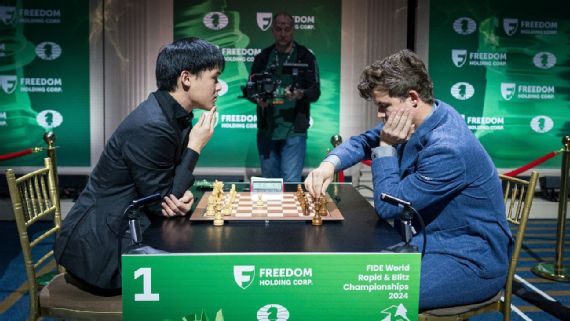
«It`s a whole different experience when you`re sitting on the board and there`s kind of no one else there to help you. It`s just you against the other guy,» he describes the intensity of solo competition. «I`m really happy because for me, I see these guys playing all the time, but I don`t really have the chance to meet them face to face, chat with them and play them especially. It`s really just been a great learning experience.»
So, what exactly is Liang’s next objective? He aims to go above and beyond the fundamental requirements, dedicating himself to the necessary steps for success, all driven by his profound and enduring love for chess.
At 22 years old, Liang firmly believes in the importance of a comprehensive learning process and dismisses the notion of shortcuts. He deeply values the opportunity to engage with and play against esteemed players like Arjun, Keymer, and Giri, considering it a privilege that he hopes will catalyze his advancement into the next stage of his chess career.
Will hard work and enjoyment alone be enough to reach the absolute top? He remains philosophical about the outcome. «Maybe they`re so far ahead that it`s going to be very difficult for me to catch them. My attitude in life is always that you can`t really control the other things, right? So, you just have to focus on yourself. And have fun doing it,» he reflects.
Indeed, at the Chennai Grand Masters 2025, few, if any, demonstrate as much sheer joy and enthusiasm for their presence as Awonder Liang.
Versión en Español
En el competitivo mundo del ajedrez, las entrevistas a menudo pueden ser un desafío para los jugadores, quienes suelen estar absortos en sus intensos horarios de preparación. Muchos profesionales del ajedrez expresan poco disfrute por las interacciones con los medios. Por ejemplo, el campeón mundial Gukesh Dommaraju es conocido por evitar todo compromiso mediático durante los torneos, a menos que esté explícitamente estipulado en sus contratos previos al evento. En este contexto, el Gran Maestro estadounidense Awonder Liang se destaca como una figura poco convencional y refrescantemente abierta.
La participación de Liang en el Chennai Grand Masters 2025, que marca su primer torneo importante en más de un año, se caracteriza por una constante serie de sonrisas y bromas, transmitiendo claramente su genuina alegría por participar. Si bien su calificación ELO clásica de 2696 lo sitúa indudablemente entre los mejores jugadores, Liang equilibra sus ambiciones ajedrecísticas con una carrera paralela como profesional de finanzas, una combinación única de actividades.
A lo largo de su infancia y adolescencia, Liang se estableció como un prodigio en el ajedrez estadounidense. En 2011, con solo ocho años, se convirtió en el jugador más joven de EE. UU. en alcanzar una calificación de 2000. Para 2015, había obtenido el título de Maestro Internacional, nuevamente como el más joven de la nación, y en 2017, con solo 14 años, se convirtió en Gran Maestro. Su trayectoria parecía indicar un camino claro hacia la cima del mundo del ajedrez.
Sin embargo, hace unos años, la perspectiva de Liang sobre el ajedrez experimentó un cambio significativo. Comenzó a sentir el inmenso desgaste mental asociado con la búsqueda del estatus de élite. Como compartió cándidamente con ESPN, «El ajedrez es una parte muy importante de tu vida, pero realmente no puede serlo todo, porque de lo contrario afectará cómo te sientes día a día. Y eso no es… eso no es muy saludable».
Actualmente, Liang está comprometido a descubrir el equilibrio ideal para su implicación en el ajedrez, aunque admite que podría haber corregido en exceso y haberse inclinado demasiado hacia un enfoque más informal. Todavía disfruta jugando partidas abiertas locales, a veces por premios tan modestos como 100 dólares, impulsado únicamente por su pasión por el juego. Esto contrasta marcadamente con jugadores de élite como Gukesh o R Praggnanandhaa, quienes ya no participan en tales eventos. Esta diferencia de filosofía es fundamental para el viaje distintivo de Liang hacia el nivel superior.
En el Chennai Grand Masters, Liang ya se ha enfrentado a Arjun Erigaisi y está programado para jugar contra Vincent Keymer, Anish Giri y Vidit Gujrathi en las próximas rondas.
Antes del torneo, Liang relató con ligereza un comentario de un amigo sobre la calificación de Arjun, que había bajado de 2800, lo que lo llevó a bromear diciendo que estaba «aquí solo para donarle algunos puntos de calificación». Sin embargo, se sorprendió mucho al descubrir que Arjun sería su oponente real en la primera ronda. «Hay que tener cuidado con lo que se desea», dijo Liang riendo, «a veces tus deseos se cumplen más rápido de lo que esperas».
En esa partida inicial, Liang logró asegurar una posición favorable en la fase de apertura, pero posteriormente cometió errores críticos, lo que llevó a su rendición después de 48 movimientos. «Simplemente sucedió», reflexionó Liang, «él era demasiado bueno».
Atribuye esta disparidad al nivel avanzado de preparación que exhiben los mejores jugadores. Si bien Liang genera constantemente ideas de apertura intrigantes en sus partidas, admite una falta de certeza en los movimientos subsiguientes. «Eso se debe a cuán profundamente te prepares», explica.
Liang ha observado extensamente a estos jugadores de élite en numerosos torneos de alto nivel, eventos en los que participan con mucha más frecuencia que él. Sentarse frente al tablero con ellos ha demostrado ser una experiencia de aprendizaje invaluable. Destacó específicamente la intensa preparación de Arjun y su inquebrantable concentración durante su partida como una profunda revelación.
«Es una experiencia totalmente diferente cuando estás sentado frente al tablero y no hay nadie más para ayudarte. Eres solo tú contra el otro», describe la intensidad de la competición individual. «Estoy muy feliz porque, para mí, veo a estos chicos jugar todo el tiempo, pero realmente no tengo la oportunidad de conocerlos cara a cara, charlar con ellos y, sobre todo, jugar contra ellos. Realmente ha sido una gran experiencia de aprendizaje».
Entonces, ¿cuál es exactamente el próximo objetivo de Liang? Su propósito es ir más allá de los requisitos fundamentales, dedicándose a los pasos necesarios para el éxito, todo ello impulsado por su profundo y perdurable amor por el ajedrez.
A sus 22 años, Liang cree firmemente en la importancia de un proceso de aprendizaje integral y descarta la noción de atajos. Valora profundamente la oportunidad de interactuar y jugar contra estimados jugadores como Arjun, Keymer y Giri, considerándolo un privilegio que espera catalice su avance a la siguiente etapa de su carrera ajedrecística.
¿Será suficiente el trabajo duro y el disfrute para alcanzar la cima absoluta? Se mantiene filosófico sobre el resultado. «Quizás están tan adelantados que me será muy difícil alcanzarlos. Mi actitud en la vida siempre es que realmente no puedes controlar las otras cosas, ¿verdad? Así que solo tienes que concentrarte en ti mismo. Y divertirte haciéndolo», reflexiona.
De hecho, en el Chennai Grand Masters 2025, pocos, si alguno, demuestran tanta alegría y entusiasmo por su presencia como Awonder Liang.